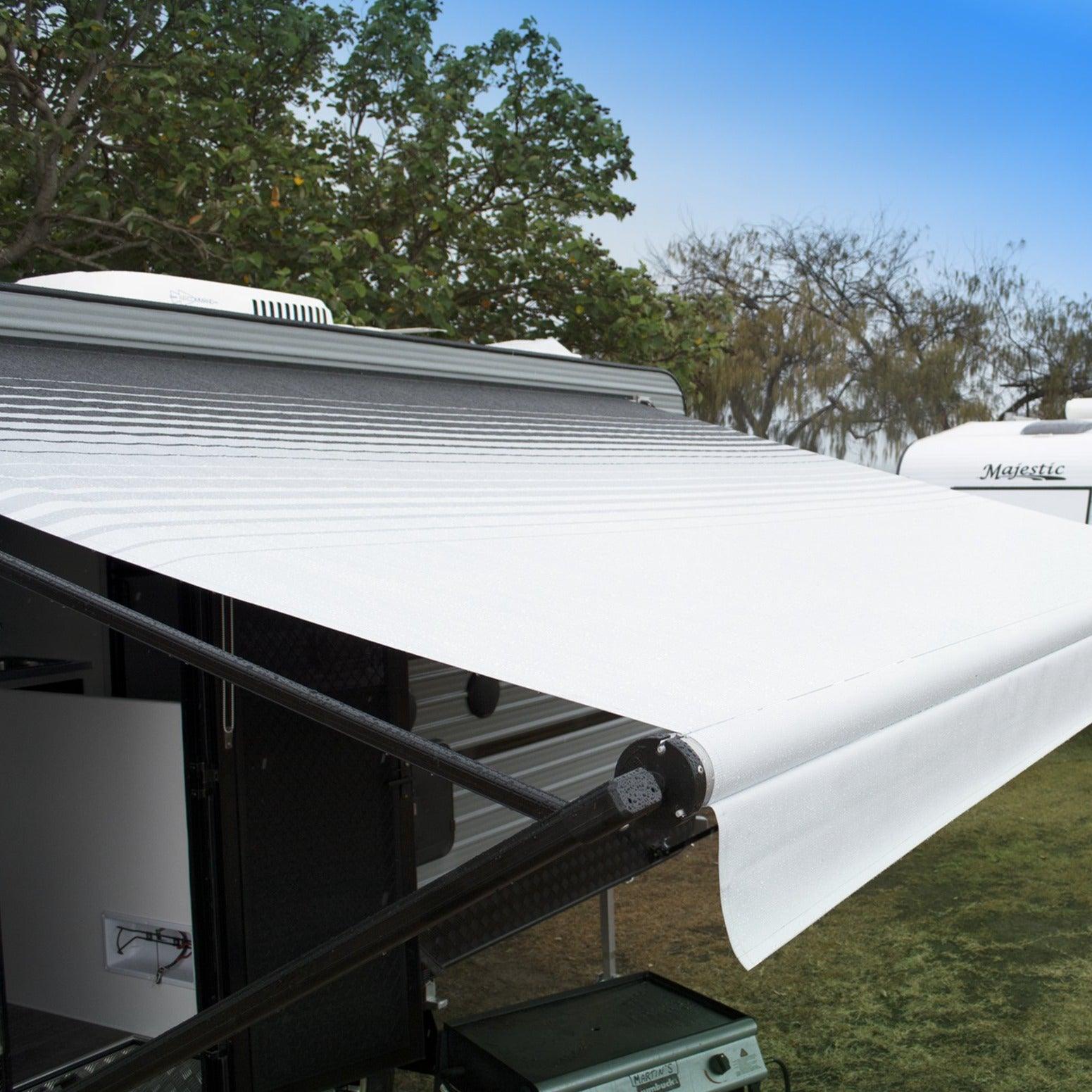


You've just set up camp after a long drive across the Western Australian outback. The awning is out, the chairs are down — and then the wind picks up. Within minutes, the awning fabric is drumming like a bass drum, sagging in the middle, and a small puddle is forming where rain is pooling instead of running off the edge. It's frustrating, it's noisy, and left unchecked, it's genuinely damaging to your awning fabric.
This is one of the most common complaints from caravanners across Australia. The good news? There's a straightforward, affordable fix — and it takes less than 30 minutes to install. This guide explains exactly what a curved roof rafter is, why awnings sag and flap in the first place, and how to choose the right rafter for your setup.
What Is a Curved Roof Rafter?
A curved roof rafter — commonly abbreviated to CRR — is a support arm that clips between the roller tube of your rollout awning and the awning fabric. Unlike a standard flat rafter, it has a deliberate arc built into its shape. That curve is the whole point.
The Curved Roof Rafter (CRR) sold by Wilfords is made by Aussie Traveller, one of Australia's most respected awning manufacturers. The CRR is designed to an exclusive curve and shape that transforms the flat profile of a standard rollout awning into a gently pitched surface — more like a tent roof than a flat sheet. It's a purpose-built solution, not a workaround.
Available in White and Black, and in three distinct designs to suit different awning sizes and vehicle types, the CRR is compatible with most rollout caravan awnings on the market. Fitting brackets are included, so everything you need for installation comes in the box.
Why Your Caravan Awning Sags and Flaps
To understand why the CRR works, it helps to understand what causes the problem in the first place.
Most rollout awnings are designed to extend horizontally from the side of your caravan, camper trailer, or motorhome. In still, dry conditions, that flat profile is fine. But introduce wind or rain, and the physics work against you.
Wind flap happens because a flat, unsupported fabric surface has no rigidity. Wind pressure causes the fabric to flex and oscillate — that rhythmic slapping sound that can make sleeping in your van almost impossible. Every flap cycle puts stress on the fabric weave and the stitching along the seams. Over time, repeated flexing weakens the material and accelerates UV degradation.
Water pooling is a closely related problem. A flat awning has no natural drainage angle. Even light rain can collect in depressions where the fabric is unsupported, creating heavy pockets of standing water. That weight increases sag, which creates deeper depressions, which collect more water. In heavier downpours, this cycle can put serious structural strain on the roller tube, the awning arm brackets, and the attachment points on your vehicle.
Long-term fabric damage is the cumulative result. The combination of UV exposure, repeated flexing from wind, and the weight stress of pooled water will shorten the service life of any awning fabric. Replacing an awning is a significant expense. Preventing damage is far more cost-effective.
How the CRR Solves These Problems
The curved roof rafter addresses all three problems through one elegant mechanical principle: it pitches the awning fabric.
When you insert a CRR between the roller tube and the fabric, it pushes the centre of the awning upward, creating a curved arch across the width. That arch does several things simultaneously.
It creates a drainage slope. The curved profile means rainwater immediately runs toward the edges of the awning rather than pooling in the middle. No standing water, no heavy pockets, no strain on the roller tube.
It reduces fabric flex. A curved, tensioned surface is far more resistant to wind movement than a flat, unsupported one. The CRR puts the fabric under gentle tension across its arch, which dramatically reduces the amplitude of any flapping. The awning becomes quieter and more stable in breezy conditions.
It protects the fabric long-term. Less flexing means less stress on the weave. Better drainage means the fabric dries faster and doesn't sit wet. Both factors meaningfully extend the working life of your awning.
The Maxi Rafter's 123–125mm arch and the Mini Rafter's 95–98mm arch represent the optimal balance between effective drainage pitch and a profile that doesn't look awkward or put excessive stress on the fabric at the attachment points.
Which Curved Roof Rafter Do You Need?
The CRR comes in three designs, each suited to a different scenario. Choosing the right one depends on two things: your awning length and your vehicle type.
Maxi Curve Rafter (#1) — 123–125mm arch
This is the go-to option for most standard caravans, motorhomes, and camper trailers running rollout awnings of any length. The larger arch gives a more pronounced pitch — excellent drainage and maximum anti-flap performance. If you have a full-size caravan with a 14-foot awning, this is almost certainly the rafter you want.
Mini Curve Rafter (#2) — 95–98mm arch
The Mini is specifically designed for pop-top caravans, where clearance between the roller tube and the fabric is reduced. It's also the right choice for shorter awnings on any vehicle type where a smaller arch is more appropriate. Available in both White and Black, it gives you a bit more flexibility on the colour match front.
Curved Tension Rafter (#3) — for awnings 18ft and over
Longer awning roller tubes have a tendency to bow under their own weight — a separate problem from fabric sag, but one that compounds it. The Tension Rafter is a standard CRR fitted with an additional tension arm that counteracts this bowing, keeping the roller tube straight along its full length. For awnings 18 feet and over, this is the recommended choice for at least one of your rafters.
How many rafters do you need?
|
Awning Length |
Rafters Required |
|
11ft and under |
1 rafter |
|
12ft |
1–2 rafters |
|
13ft – 17ft |
2 rafters |
|
18ft – 21ft |
3 rafters* |
|
22ft and over |
4 rafters* |
*For awnings 18ft and over, substitute at least one standard CRR with a Curved Tension Rafter (#3).
Cassette awnings: Only 1 curved roof rafter is required regardless of awning length. The cassette housing provides structural support that means additional rafters aren't necessary.
CRR + Anti-Flap Kit: The Complete Solution
The curved roof rafter and the Anti-Flap Kit are designed to work together — and combining both is the most popular upgrade our team at Wilfords recommends.
Here's the distinction: the CRR pitches the roof of the awning to manage water runoff and reduce overall fabric flex. The Anti-Flap Kit addresses a different but complementary issue — it tensions the lead rail and the side panels of the awning to eliminate the specific slapping and drumming that occurs at the awning's edges and ends in windy conditions.
Together, they cover all the angles. The CRR handles the top surface; the Anti-Flap Kit takes care of the perimeter. For caravanners who spend time in exposed sites — coastal spots, outback plains, or the high country — running both is the most comprehensive protection you can give your awning. Browse the full range of Anti-Flap Kits & Curved Roof Rafters to see the options available.
Western Australia is particularly unforgiving on awnings. The Fremantle Doctor alone is enough to send an unsupported awning into full drum-solo mode. If you're travelling through WA — whether you're heading up the coast to the Kimberley or exploring the south-west — investing in both products before you leave Perth is money very well spent.
DIY Installation: What's Involved
Installing a curved roof rafter is a straightforward DIY job. The fitting brackets are included with every CRR, so there's nothing extra to source.
The general process involves attaching the fitting bracket to the awning roller tube, sliding the rafter arm into position between the tube and the fabric, and securing it at the outer end. No drilling is required for most standard rollout awnings. The whole job typically takes under 30 minutes, even for first-timers.
If you'd prefer not to tackle it yourself, or if you're pairing the CRR installation with a more involved awning upgrade, Wilfords offers professional fitting services from our Maddington workshop. Our team has been working on caravan awnings since 1979 — if there's a fitment question, we've almost certainly seen it before.
Frequently Asked Questions
Will a curved roof rafter work with my brand of awning?
The Aussie Traveller CRR is designed for compatibility with most rollout awnings on the market. The key factors are the profile of your roller tube and the fabric type. If you're unsure whether the CRR will suit your specific awning, contact our team in Maddington and we'll help you confirm compatibility before you order.
Can I fit a curved roof rafter to a cassette awning?
Yes — cassette awnings can use one CRR regardless of their length. The cassette housing provides inherent structural support, so you need only a single rafter rather than scaling up with awning length the way you would with a standard rollout.
Do I need the Tension Rafter (#3) if my awning is 18 feet?
For awnings 18 feet and over, we recommend substituting at least one of your standard CRRs with a Tension Rafter. The tension arm prevents the roller tube from bowing under its own weight across that longer span — a problem that becomes noticeable at 18 feet and above.
What's the difference between the curved roof rafter and the anti-flap kit?
They solve related but distinct problems. The CRR creates a pitched arch in the roof of the awning, improving water drainage and reducing overall fabric movement. The Anti-Flap Kit tensions the lead edge and sides of the awning to stop the characteristic drumming and slapping at the perimeter. Using both together gives you the most complete solution. Browse our awning parts and accessories for the full range of complementary products.
Ready to Stop the Sag? Shop Wilfords
A curved roof rafter is one of those upgrades that costs very little but makes a genuinely noticeable difference to every trip. Quieter camps, drier awning fabric, and a setup that holds its shape in the wind — it's a straightforward improvement that pays for itself quickly in extended fabric life.
Wilfords has been the specialist choice for Western Australian caravanners since 1979. Our team in Maddington knows awnings inside and out, and we carry the full range of Aussie Traveller curved roof rafters — Maxi, Mini, and Tension — in both White and Black, ready to ship Australia-wide.
Shop the Curved Roof Rafter (CRR) online now, or contact our team in Maddington if you'd like help working out which variant and how many you need for your setup. Four decades of awning experience — we're happy to help you get it right.