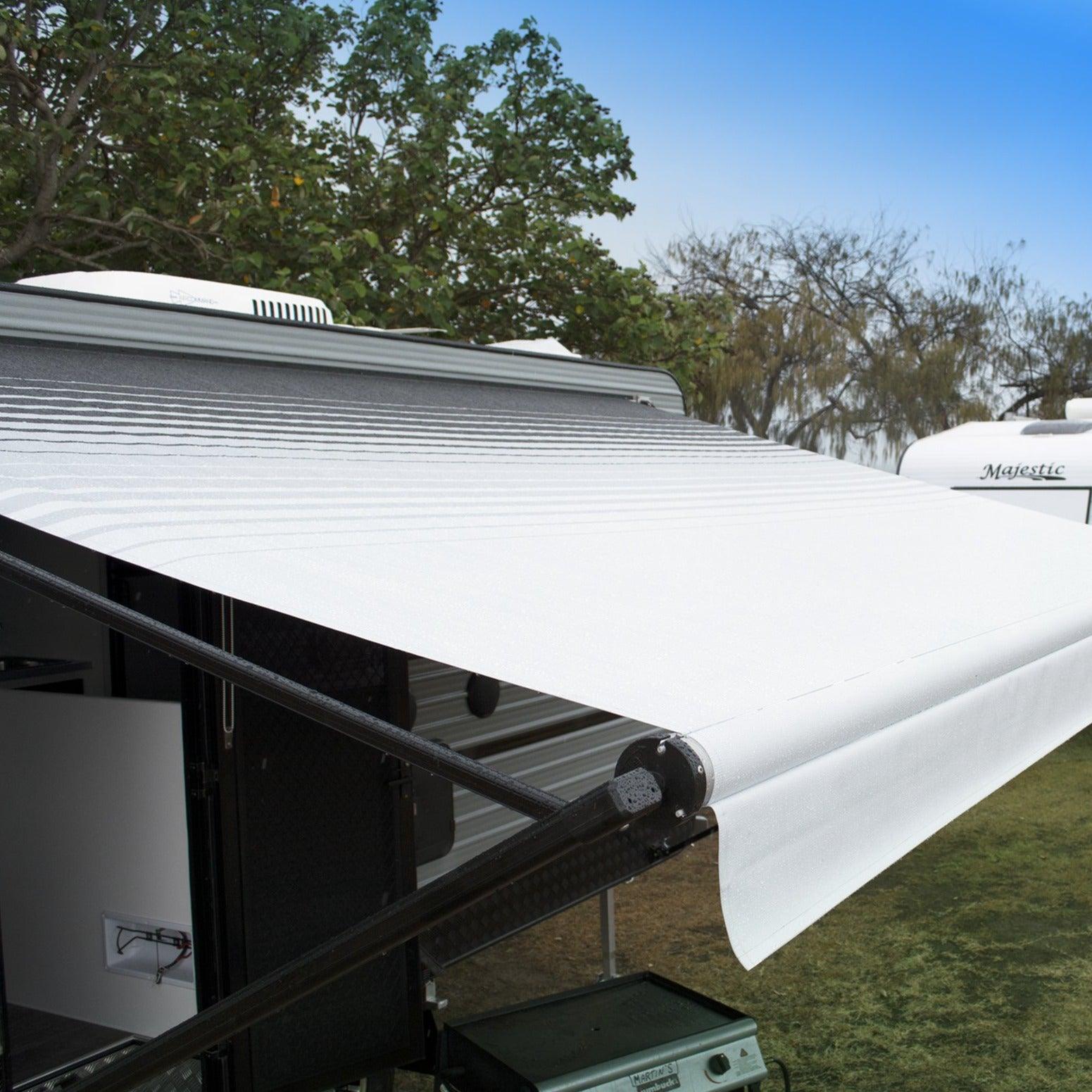


You pull into a coastal site, wind the awning out, and within an hour the fabric is drumming, sagging in the middle and holding a puddle after the first shower. Two products get recommended for that problem - curved roof rafters and anti-flap kits - and it is not always clear whether you need one, the other, or the pair.
Wilfords has been fitting and supplying caravan awnings, annexes and awning accessories from Maddington, Western Australia since 1979. If your awning is sagging or noisy, knowing what each accessory does will help you choose the right setup..
This guide explains what each product actually does, where the two differ, how to decide whether both are worth it for your setup, and how many rafters your awning length calls for.
What a Curved Roof Rafter Does
A curved roof rafter - usually shortened to CRR - is a support arm that sits between your awning roller tube and the fabric. The arc built into it is the whole point: it lifts the centre of the awning so the roof carries a pitch instead of sitting flat.
That pitch does two jobs at once. Rainwater runs to the edges rather than collecting in the middle, and the tensioned curve gives the fabric far less room to move when the breeze gets up.
The Curved Roof Rafter range from Aussie Traveller is made to an exclusive curve and shape, comes with fitting brackets included, and suits most roll-out awnings. It is available in three designs:
- Maxi Curve Rafter (#1) - a 123–125mm curve, suitable for longer awnings on all vehicle types
- Mini Curve Rafter (#2) - a 95–98mm curve, suitable for awnings of all lengths on pop-top caravans, or for shorter awnings on all other vehicle types
- Curved Tension Rafter (#3) - a standard CRR fitted with a tension arm, for longer awnings 18' and over
The Mini Curve Rafter is the design offered in Black as well as White, which matters if you are matching darker hardware along the side of the van.
What an Anti-Flap Kit Does
An anti-flap kit works on a different part of the awning. Rather than lifting the roof, it clamps along the outer edge of the awning fabric and holds it under constant tension, which is what stops the slapping and drumming that keeps a campsite awake.
There is a second benefit that often gets overlooked. The kit's sail-track design gives you a mounting point for privacy screens, shade walls, annexes and porches, so the awning becomes the frame for a proper outdoor room rather than just a patch of shade.
Wilfords lists two current Aussie Traveller anti-flap kit designs. Both are around 20% lighter than the original kit and available in White and Black. Check the product pages for current availability before ordering.
-
The Anti-Flap Kit PRO suits awning projections from 2100mm to 2400mm. It is not suitable for cassette or other awning types.
-
The Anti-Flap Kit PRO+ suits projections from 2100mm to 2500mm and includes eight end attachments, which is what makes it the option for cassette and most other RV awnings.
If you have been searching for an Aussie Traveller black anti-flap setup, both PRO and PRO+ are available in Black - the choice between them comes down to your awning projection and awning type, not colour.
Curved Roof Rafters vs Anti-Flap Kits: The Key Difference
The clearest way to hold the distinction in your head is to think about which part of the awning each product controls.
A curved roof rafter works on the top surface. It shapes the roof, sheds water and takes the slack out of the fabric across the width of the awning.
An anti-flap kit works on the perimeter. It secures the outer edge, kills the flapping at the lead rail, and adds sail track for walls and screens.
Wilfords' own guidance on the Anti-Flap Kits & Curved Roof Rafters collection puts it plainly: anti-flap kits prevent fabric flapping by securing the awning's edge, whilst curved roof rafters provide structural support along the length to prevent sagging and assist water drainage. They are solving related problems from opposite directions.
That is also why swapping one for the other rarely works. A rafter on its own will not quieten a loose lead rail, and a kit on its own will not stop water pooling in the centre of the roof.
Do You Need Both?
For the most stable setup, the product guidance recommends using a curved roof rafter with an anti-flap kit.
Start with a curved roof rafter if sagging, water pooling after rain, or stretched fabric is your main concern. The CRR is designed to support the awning roof, reduce sagging and assist water run-off.
Start with an anti-flap kit if noise is the problem, you camp in exposed coastal or plains sites, or you plan to add shade walls, privacy screens or an annexe. The sail track alone changes what your awning can do.
Run both if you want support across the roof as well as tension along the awning edge, and follow the manufacturer’s weather and use instructions rather than leaving an awning unattended.
Bundled pairings of an anti-flap kit with a curved roof rafter are also available, which is usually the practical route if you have decided on both from the outset rather than adding the second product a season later.
How Many Do You Need?
Anti-flap kits are sized by awning projection, so you need one kit matched to your awning. Rafters are different - the number scales with awning length. The published guidance is:
|
Roll-out awning length |
Curved roof rafters required |
|---|---|
|
11ft and under |
1 rafter |
|
12ft |
1–2 rafters |
|
13ft – 17ft |
2 rafters |
|
18ft – 21ft |
3 rafters* |
|
22ft and over |
4 rafters* |
*For awnings 18ft and over, substitute one of the curved roof rafters with a Curved Tension Rafter. The tension arm is there to stop longer roller tubes from bowing under their own weight.
Cassette awnings are the exception. Only one curved roof rafter is required regardless of awning length. Remember that cassette awnings also need the PRO+ rather than the PRO if you are adding an anti-flap kit.
If you are unsure of your awning length or projection, measure before ordering rather than estimating from the side of the van - an awning that reads as 14 feet at a glance can easily fall either side of a size break.
Fitment and Compatibility
Both products are designed to suit most roll-out awnings, and the CRR includes fitting brackets. Check the awning type, projection, vehicle clearance and existing hardware before fitting, or ask Wilfords about fitment and installation.
Compatibility is still the step worth checking before you order. The two things that decide it are:
- Your awning projection - this determines if any adapters are required for the AFK length
- Your awning type - roll-out or cassette, which determines PRO versus PRO+
- Your vehicle - pop-top clearance is what pushes many owners to the Mini Curve Rafter
- Your awning length - the figure that sets rafter quantity and whether a Tension Rafter belongs in the mix
- Any existing hardware - brackets, sail track or a frameset already fitted to the van
If you would rather not do the fitting, Wilfords' fitment and installation services cover the installation of sail track, press studs, and AFK and CRR brackets, alongside annexe measure and install work. That can be the better option if you are combining an awning accessory upgrade with annexe preparation on the same visit.
It is also worth planning the whole setup together. If a new awning is on the cards, the roll-out awnings range and your accessory choices are easier to match up front than to retrofit around each other later.
Curved roof rafters and anti-flap kits solve different parts of the same awning problem. Aussie Traveller designs them to complement each other, with the rafter supporting the roof and the kit securing the outer edge. Whether you need one or both comes down to your awning length, projection, vehicle type and how you travel.
Bring those four details to us and we will confirm the right combination and quantity for your van. Browse the range online, or contact Wilfords on 08 9459 5155 or at info@wilfords.com.au for advice from our team at 6 Church Road, Maddington, WA.